
Building Synergy Between AI and Product

Leveraging AI can significantly enhance your business by establishing a protective moat around it, making it resistant to competitive imitation. AI belongs to a limited group of technologies that has the potential to spark a network effect for your organization, product or service. It does this by converting customer data into a product enhancement, which others, without access to the data, can't replicate. The network effect is the secret sauce behind business superiority in the tech sphere. When executed correctly, AI technologies can skyrocket your organization to unparalleled success and help you stay there, keeping late-entrant competitors at bay.
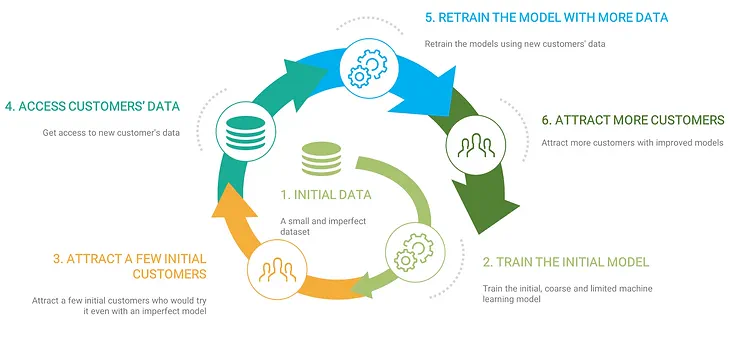
However, building an AI company requires more than merely utilizing AI technologies for your product. You must set off a virtuous AI cycle: your models should capitalize on exclusive, hard-to-access data to improve your product. The resulting product improvement should yield more proprietary data to enhance your models further. This process forms a positive feedback loop, the cornerstone of any network effect.
This loop, however, doesn't materialize effortlessly. Two key aspects need attention to transform into an AI-centric company that leverages customer data.
1. Improved model performance should heighten the perceived product value.
Understanding what your customers perceive as product value is absolutely pivotal. As you source your data from customers, a superior model should boost the customer base and increase customer engagement with the product (thereby supplying more data as the model performance escalates) or both. The scenario becomes more intricate when multiple models enhance various aspects of your product.
Overlooking key value points and investing in AI models that only serve secondary value points may render your AI cycle inferior to those of late entrants who've nailed it. Another company may establish a superior AI cycle and push you out of the market. It's essential to remember that AI products tend to follow a 'winner-takes-all' principle, and the second-best product could generate orders of magnitude lower returns than the first — consider Google Search and Bing.
Therefore, your AI strategy and practices should be primarily product-focused. Your machine learning engineers and researchers must consistently evaluate each AI initiative against the value proposition and product design. Even the top-performing models that don't contribute to the perceived product value merely consume effort unnecessarily.
2. A superior product should generate more data to improve your models.
Identifying the perceived value points is crucial but not sufficient. Customer engagement with the product should provide ample data that you can utilize to train your AI models further. To accomplish this, keep two factors in mind.
First, data stems from customer interaction with your product. The customer journey dictates these interaction points and their sequence — a product design blueprint outlining how the customer will derive value from interacting with your product. For an AI company, your customer journey should be data-focused: your product managers and teams should prioritize data generation at each step of the product design process.
Second, the data should be applicable for refining your existing machine learning models. The performance of these models contributes to the perceived product value, so you need them to improve with increased users and engagement. If your product team crafts a customer journey that generates data unfit for the AI team to enhance the models, your virtuous AI cycle grinds to a halt, leaving your business vulnerable to late-entrant competitors who create a similar product but design a better customer journey.
Thriving AI companies are underpinned by seamless collaboration between product and AI teams. This collaboration requires mutual understanding: the AI team needs to grasp the product's value proposition, customer development, current and anticipated user research, A/B testing results, and other product management methodologies. On the other hand, the product team should comprehend the type of data that enhances the company's AI models, the existing data quality and quantity issues, potential biases in the datasets, and what data could optimize the current models' performance.
This rapport between AI and product teams isn't a one-off event; it must be cyclical. Here, we propose a checklist for both AI and product teams to ensure this cooperative cycle is functioning and that the company maintains a robust AI product development cycle.
Checklist for the AI Team
For self-evaluation, the AI team should consistently check the following questions:
- What is our product's value proposition? What problems does our product address?
- What do customers perceive as key value points of our product? Which are most critical? How do we know this? Do we have data and research supporting our understanding?
- Do our models directly enhance the perceived value points?
- How do we measure our models' impact on the perceived product value? What product metric should elevate with increased model performance for each of our AI models?
- Do we utilize perceived product value points to plan and prioritize our new AI initiatives?
- Are our machine learning efforts aligned with the user journey in the product? Are we considering how to capture data that would be advantageous to product and user experience improvement?
- Do we regularly communicate with the product team to understand the product roadmap, potential new features, and how our AI initiatives can support them?
- What are our datasets' current restrictions and biases, and how are they affecting our AI models? How can we overcome these restrictions and enhance the quality of our data?
- Are we frequently auditing our models for biases, and do we have strategies in place to minimize their impact?
- Do we have effective systems in place for monitoring and maintaining our models once they are in production? Are we ensuring the continuous performance of our AI models with real-time metrics?
If your AI team has answers to most or all of these questions, it indicates a robust product- and business-centric approach in your AI practices and strategy.
Checklist for the Product Team
In turn, the product team should routinely perform their own self-check to ensure that their product designs are synchronized with the company's AI strategy. They should consider the following questions:
- Do we understand which AI models contribute to which product value points?
- Do we comprehend what data can enhance the performance of each of these models?
- Are we aware of our current datasets' biases and restrictions and the data our product generates?
- Does our user journey generate data the AI team can use to improve model performance? Do we regularly refine the user journey to produce more useful data without compromising the perceived product value?
- Do we know what data is most and least likely to improve the AI models' performance?
- Do we factor in data generation when assessing and prioritizing new product initiatives?
- Are we utilizing feedback from the AI team to update our product roadmap and feature prioritization?
- Do we include the AI team in our early product design and brainstorming sessions? Are we ensuring AI perspectives are integrated from the start of the product development cycle?
- Do we clearly understand the metrics the AI team uses to measure model performance, and do we know how these tie back to our product metrics?
- Are we routinely incorporating user feedback to validate or refute our assumptions about the value delivered by our AI models?
Conclusion
Just like tango, building an AI product takes two. Successful AI product management isn't solely about the independent excellence of AI and product teams; it's about their synergy. It's a dynamic process demanding ongoing iteration, much like your AI models. In today's fiercely competitive landscape, harmonising your AI and product teams is a non-negotiable for retaining a competitive edge.
Related Reading
- Why Do You Need an AI Strategy? AI as a Competitive Advantage
- All You Need Is a Network Effect: How Great Tech and AI Products Compete
- AI Strategies That Offer a Sustainable Competitive Advantage
- Planning for a New AI Initiative? Start with the Right AI Development Culture
- Four AI Designs That Don't Work
- Lacking Data for Machine Learning Models? Build for the Future Data
Struggling to Align Your AI and Product Teams?
Let's build the cross-functional collaboration framework that turns your AI investment into a true product advantage.