
Four AI Designs That Don’t Build an Advantage
By Sergii Shelpuk,Managing Partner at Shelpuk & Company

Are you seeking a competitive edge in today's rapidly-evolving business landscape? Consider the AI network effect, a game-changing strategy that has transformed companies' operations. By leveraging proprietary data, AI businesses are harnessing the power of machine learning technologies to capture and dominate the market while keeping the competitors at bay.
But not all AI strategies are created equal. In fact, some can actually hinder your growth and put your business at a disadvantage. Let me introduce you to four common AI designs that can lead you astray. Avoiding these pitfalls allows you to position your business for success and stay ahead of the curve.
1. Using third-party AI products
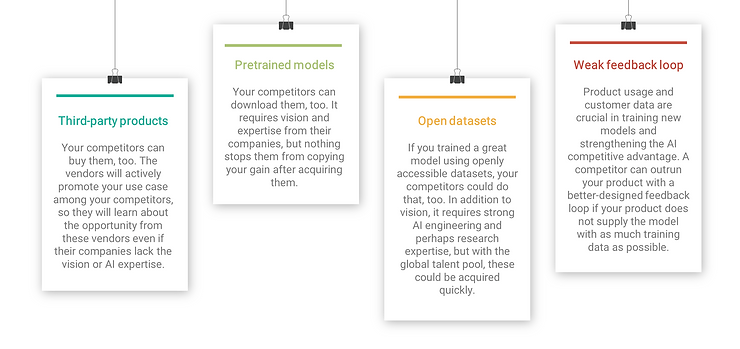
While relying on pre-built AI solutions for tasks like sentiment analysis, text translation, or image recognition may be tempting, this approach will not give you a leg up on the competition. Not only can your competitors purchase the same products, but the vendors themselves may actively promote your use case to your rivals. Even companies without AI expertise or vision can easily catch up to your level with the help of these out-of-the-box solutions.
2. Harnessing pre-trained models
Another common mistake is relying on pre-trained models or cloud APIs to drive your AI strategy. While these resources can be useful for certain tasks, they will not give you a lasting competitive advantage. Your competitors can easily access the same pre-trained models from sites like Huggingface, meaning that they can replicate your results without much effort.
3. Relying on open datasets
Using open datasets can be a useful starting point for building an AI model. However, if you do not plan on training your model further using proprietary data, it will not give you a sustainable competitive advantage. Anyone can access the same open dataset and train a similar model, so you will not have a unique value proposition. Even if you manage to train a great model using open datasets, your competitors can quickly replicate your results with the right expertise and resources.
4. Weak feedback loop
Having a strong feedback loop is crucial for any successful AI strategy. The AI model should improve your product, which should generate more data that can be used to train the AI model further. This requires a shared vision and collaboration between the AI and product teams. If the feedback loop does not provide useful data for the AI model or provides too little of it, a competitor who designs a better feedback loop can easily outcompete you.
Simply put, if you want to build an AI company and gain a competitive advantage, you cannot solely rely on third-party AI products, pre-trained models, or open datasets. These tools can enhance productivity in the short term but are not a sustainable solution for building a true AI company. You must train and retrain machine learning models with your proprietary data to achieve a real competitive edge. This requires a strong focus on data gathering and model training infrastructure, technology, and management practices.
This blog is dedicated to AI competitive advantage, and we are doing our best to explain how it works and how you can build one for your product or company. You can check our other posts to get an extensive explanation of what the network effect is and how AI enables it, what culture helps you build the right AI products, and what to avoid in your AI strategy and execution.
Are Your AI Investments Truly Defensible?
Let's assess whether your AI strategy builds lasting competitive advantage — or whether your competitors can easily replicate it.